
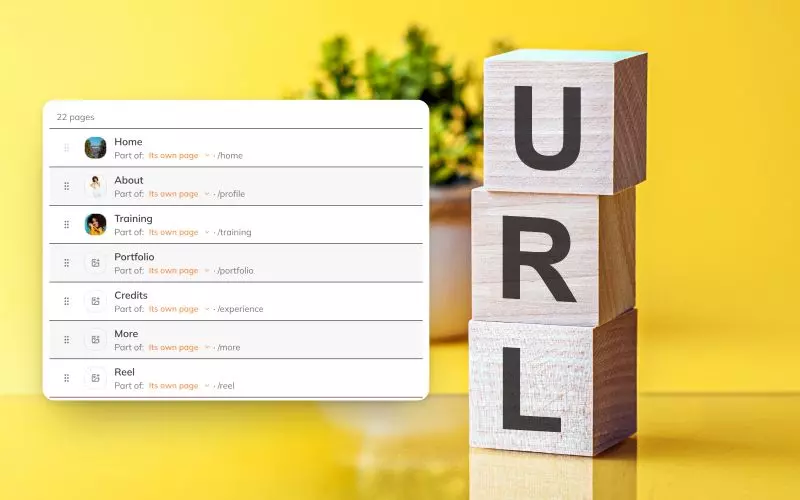
Every page on your website has its own address, and the shape of it is deliberately plain: your account name, then the name of the page. That is what gets pasted into a casting profile, printed on a card, and indexed by a search engine, so it is worth understanding how it is built and what you can change.
How one is formed
The page name comes from what you called the page. Name a page Resume and it lives at the resume address. Rename it and the old address keeps working, because an address is only useful if it survives you tidying up your menu.
If you would rather choose the address yourself, you can. Custom slugs let you be at /about rather than /profile, or /reel rather than /video, which reads better on a card and is easier to say out loud.
Connecting your own domain replaces the account-name part with your domain, and every page address follows automatically. Nothing about your pages needs redoing.
What happens to an address that does not exist
It returns a proper not-found response. That sounds like a small thing and it is not.
The alternative, which plenty of sites do, is to quietly show the home page instead. That looks friendlier and is worse for everyone. A visitor who followed a specific link gets silently redirected somewhere they did not ask for and assumes the page they wanted does not exist. A search engine sees several addresses returning identical content and treats it as duplication, which works against every page on the site.
An honest error is better than a confident wrong answer. Not-found responses are also recorded, so patterns get noticed rather than waited on, which is covered in link monitoring across your site.
Worth thirty seconds
Open your own site in a private browser window and click through every menu item. Then take one inner page address, paste it fresh into the address bar rather than navigating to it, and confirm it lands where you expect.
The reason to paste rather than click is that you almost never arrive at your own site the way a stranger does. You come in through your own menu. A visitor comes in from a search result, an email, a card or a casting profile, straight to an inner page, which is a different path through the same site.
Related: canonical URLs and automatic sitemaps, both of which build on addresses being stable.
Finished reading? Build yours next.
It takes about 76 seconds and it starts free, with your credits, headshots and reels already in it.
Build mine free→